
Walk into any kitchen and the first thing you’ll probably notice is the cupboards. Their doors, finishes and handles cover more surface than almost anything else in the room, so they give the space its feel more than almost anything else.
There’s more to kitchen cupboards than just the exterior, though. The materials, construction and hardware used for the carcasses (the box that forms the body of the unit) are a major factor in deciding how well your kitchen will hold up to daily use.
In this guide, we explore both sides of the cabinet door. We’ll cover how cupboards are made, the finishes and hardware that bring them to life and the most popular door styles, along with a look at storage, budget and installation.
Key considerations before designing your kitchen cupboards
A few factors shape every choice that you’ll need to make about your kitchen cupboards, so it’s worth having a clear view on each before you settle on a style.
- The look you want to live with: Some styles have stayed popular for decades, while others capture a particular moment. Think about whether you’d like cupboards that feel current or something a little more traditional.
- Cost: Door style and construction influence the price of kitchen cupboards. For example, inset cabinets demand more precise craftsmanship than standard overlay doors and are priced accordingly.
- Durability: Some materials and finishes are designed to cope with heat, moisture and daily knocks far better than others.
- Upkeep: High-gloss doors show fingerprints, detailed profiles collect dust and natural timber needs periodic resealing. Choose finishes that match the time you’re happy to spend on care.
Should you choose flat-pack, modular or custom kitchen cupboards?
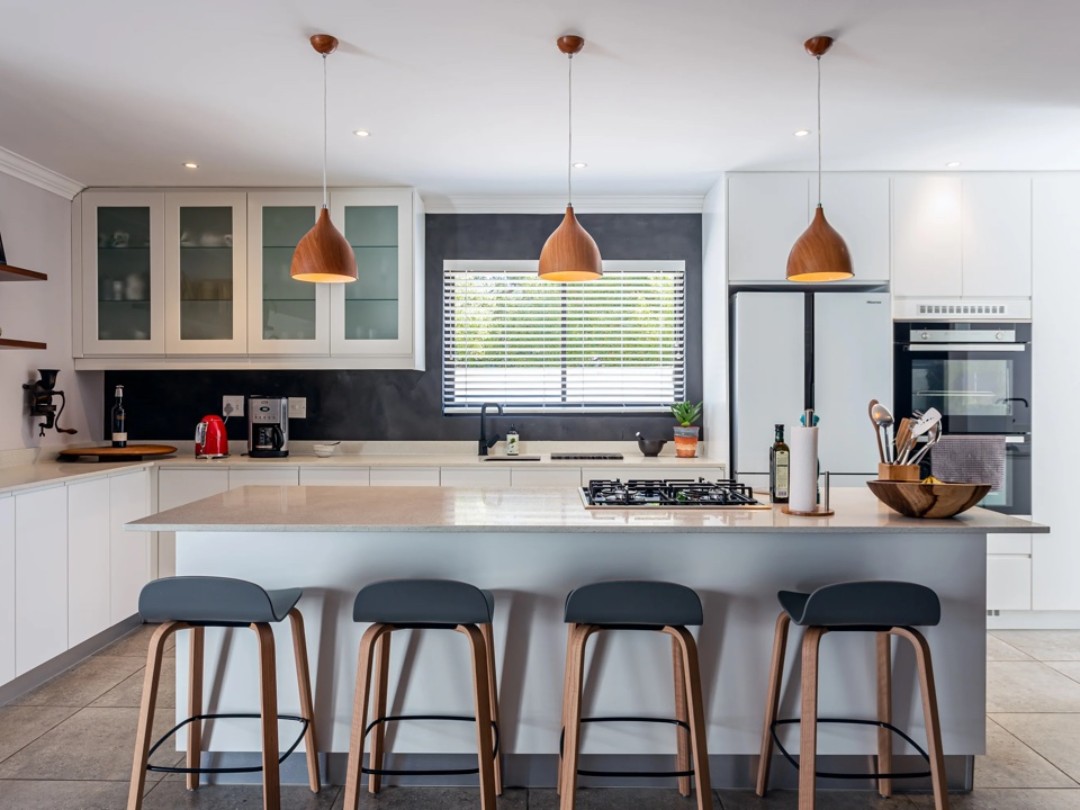
The type of cabinetry you choose is usually the first decision you’ll make. This shapes how your cupboards look, how closely they fit your space and what you’ll pay for your project.
Flat-pack units arrive boxed for self-assembly in set sizes. They usually come in a limited range of door styles and finishes, which makes them the most affordable option. Modular units come pre-made in standard widths that you combine to suit your room, with filler panels closing any gaps.
Custom cabinetry, on the other hand, is designed and built to the millimetre for your space. Plus, every cupboard type, door style, finish, edge profile and internal fitting is yours to choose.
What materials and finishes will you use when designing kitchen cupboards?
Every cupboard is made up of two parts. The carcass provides the structure, while the exterior (the doors, drawer fronts and visible panels) defines the look.
Core materials
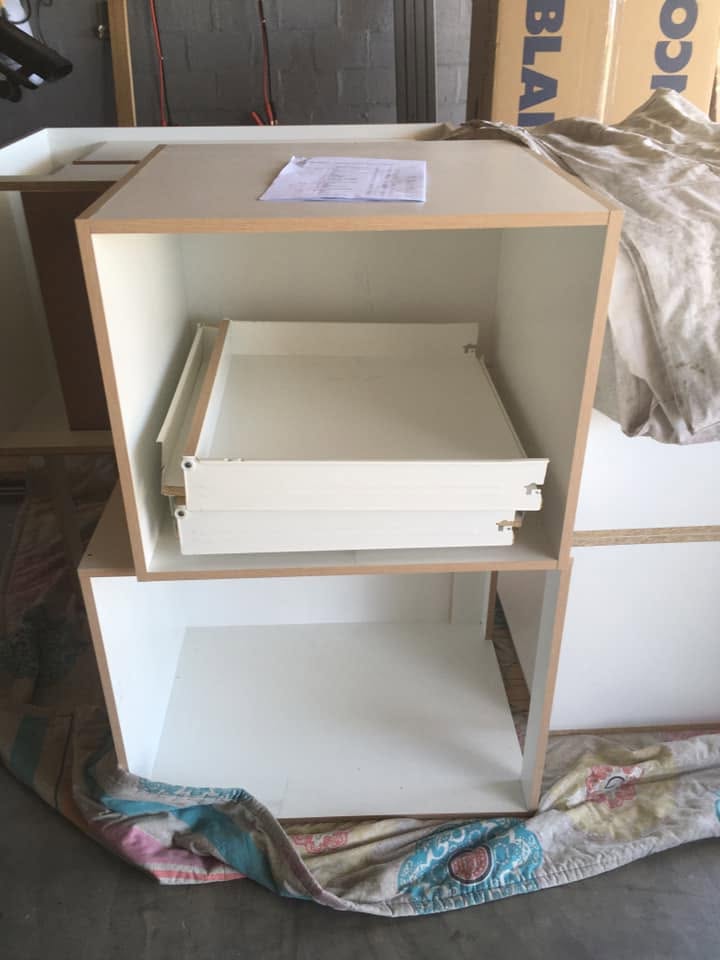
Carcasses can be built from solid wood, plywood, medium-density fibreboard (MDF) or chipboard (also known as particle board) as these engineered woods tend to be strong and stable.
Melamine-faced chipboard is the standard for kitchen unit carcasses in South Africa as it’s stable, durable and easy to keep clean. It comes in a wide range of colours and woodgrains, and we particularly like pairing a solid-colour kitchen with wood-look interiors that reveal a flash of warmth each time you open a door.
Base units (the ones that sit on the floor) should stand on height-adjustable legs concealed behind a kickboard. These keep the units level on uneven floors and raise them clear of water in the event of a leak or flood.
Finishes
The finishes you choose will affect how your cupboards look, how well they hold up to heat and moisture, and how easy they are to keep clean and maintain over time.
| Finish | Description | Heat resistance | Moisture resistance | Ease of cleaning |
| Melamine | A smooth, even surface in solid colours and realistic woodgrains | Good | Good (with sealed edges) | Easy |
| PVC wrap | A seamless vinyl surface pressed onto MDF | Low (needs heat shields near ovens) | Good | Easy |
| Laminate | A dense, hard-wearing surface in matt, gloss or textured finishes | Excellent | Excellent | Easy |
| Spray-painted lacquer | A seamless painted surface in any colour and sheen | Good | Good | Easy in matt; gloss shows fingerprints |
| Hand-painted | A soft, slightly textured surface suited to traditional profiles | Moderate | Moderate | Needs gentle care |
| Wood veneer and solid wood | A natural timber surface with grain that deepens with age | Moderate | Moderate (needs sealing) | Needs gentle care and periodic resealing |
Hardware
Cabinet hardware does two jobs. Handles, knobs and pulls add the finishing detail to your cupboards, while hinges and drawer runners do the hard work out of sight.
Most cupboards use concealed hinges that sit inside the door and allow fine adjustment, and soft-close versions bring each door to a quiet stop. Drawers run on ball-bearing or concealed undermount runners, with full-extension designs letting you reach the very back. Because hinges and runners work thousands of times a year, it’s a smart place to invest in your kitchen reno.
Handles come in a wide range of shapes and finishes. Slim bar handles and edge pulls suit contemporary doors, while knobs and cup handles complement traditional profiles. Brushed brass and bronze add warmth, matt black creates contrast and stainless steel or nickel keeps the look crisp.
Popular kitchen cabinet styles
Door style defines the personality of your cupboards. The five cabinet designs below are by far the most popular in South Africa and the feel can be entirely different depending on the finish and hardware you choose.
Shaker cabinets
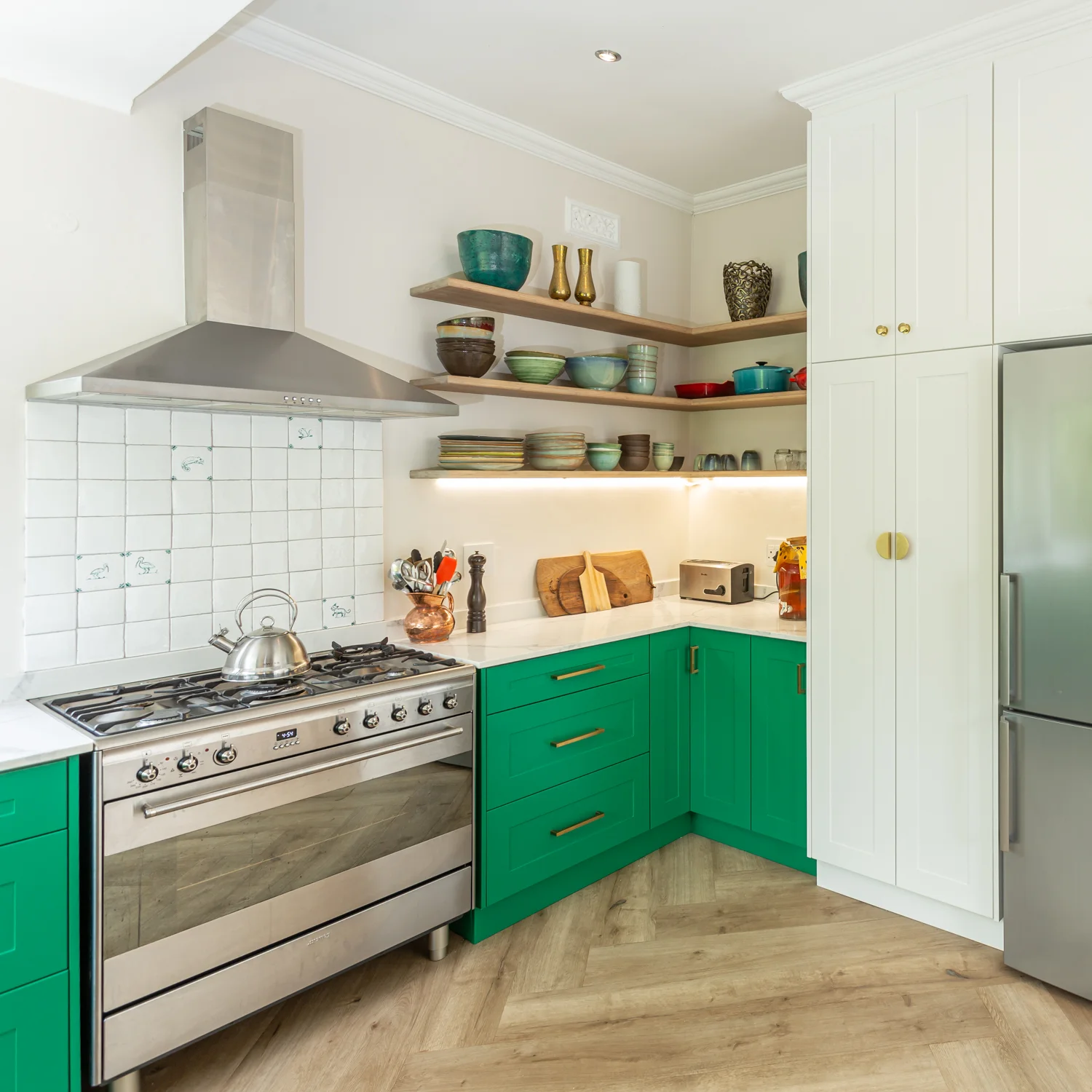
Shaker doors are instantly recognisable. They have a recessed centre panel with a simple square frame that can give your kitchen character without making it feel too busy.
Rooted in 19th-century furniture-making, the style feels as at home in a period house as it does in a contemporary apartment. In a hand-painted sage, navy or warm white, Shaker feels relaxed and traditional, especially alongside timber worktops. The same profile in high gloss or a crisp matt reads as clean and modern.
Hardware plays its part too. Brushed brass knobs and cup handles lean towards the classic, whereas slim matt black bar handles give the style a more contemporary edge.
Flat-panel cabinets
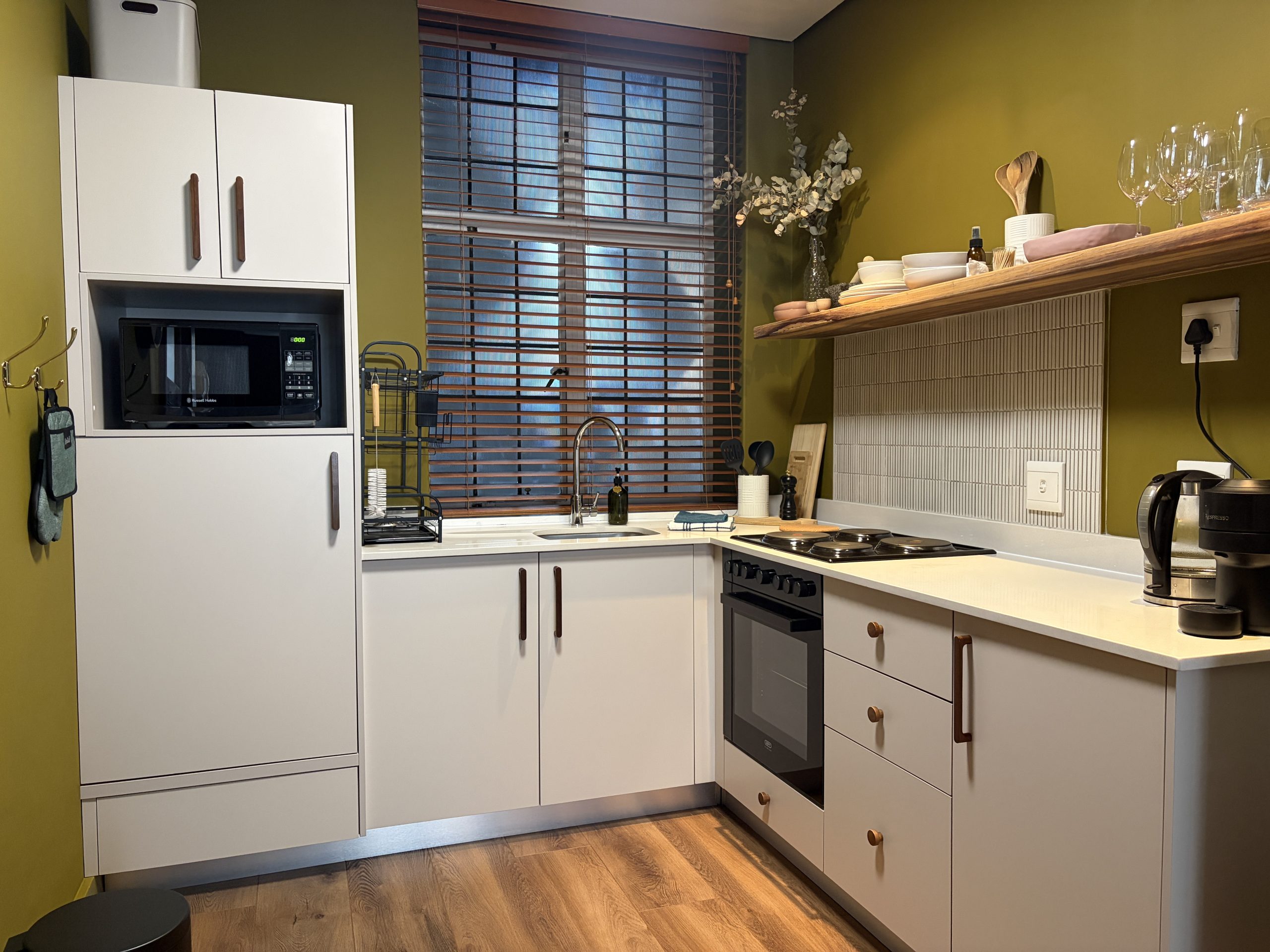
Flat-panel cabinets, also called slab cabinets, have a single smooth surface with no frame, profile or detailing. As there’s nothing to interrupt the surface, the finish itself takes centre stage. This works well for high-gloss lacquer, richly figured veneer and textured laminate.
You can use handles to add a bit of interest to the design or you can skip them entirely and go for J-pull (which have a finger grip shaped into the top or side edge) or push-to-open doors and drawers.
Inset kitchen units
Inset units have a furniture-like look. Rather than sitting over the front of the cabinet, each door and drawer fits inside a frame and sits flush with it.
The style lends itself to Shaker or beaded doors in painted finishes. Cupboard doors can be finished with concealed hinges for a clean look or with visible butt hinges and decorative finials for a more traditional feel.
Inset doors take more time and skill to build and fit, so they’re typically priced higher than overlay doors. The frame also takes up some interior space, so you won’t have as much room as with typical carcasses.
Glass-front cabinets & open shelving
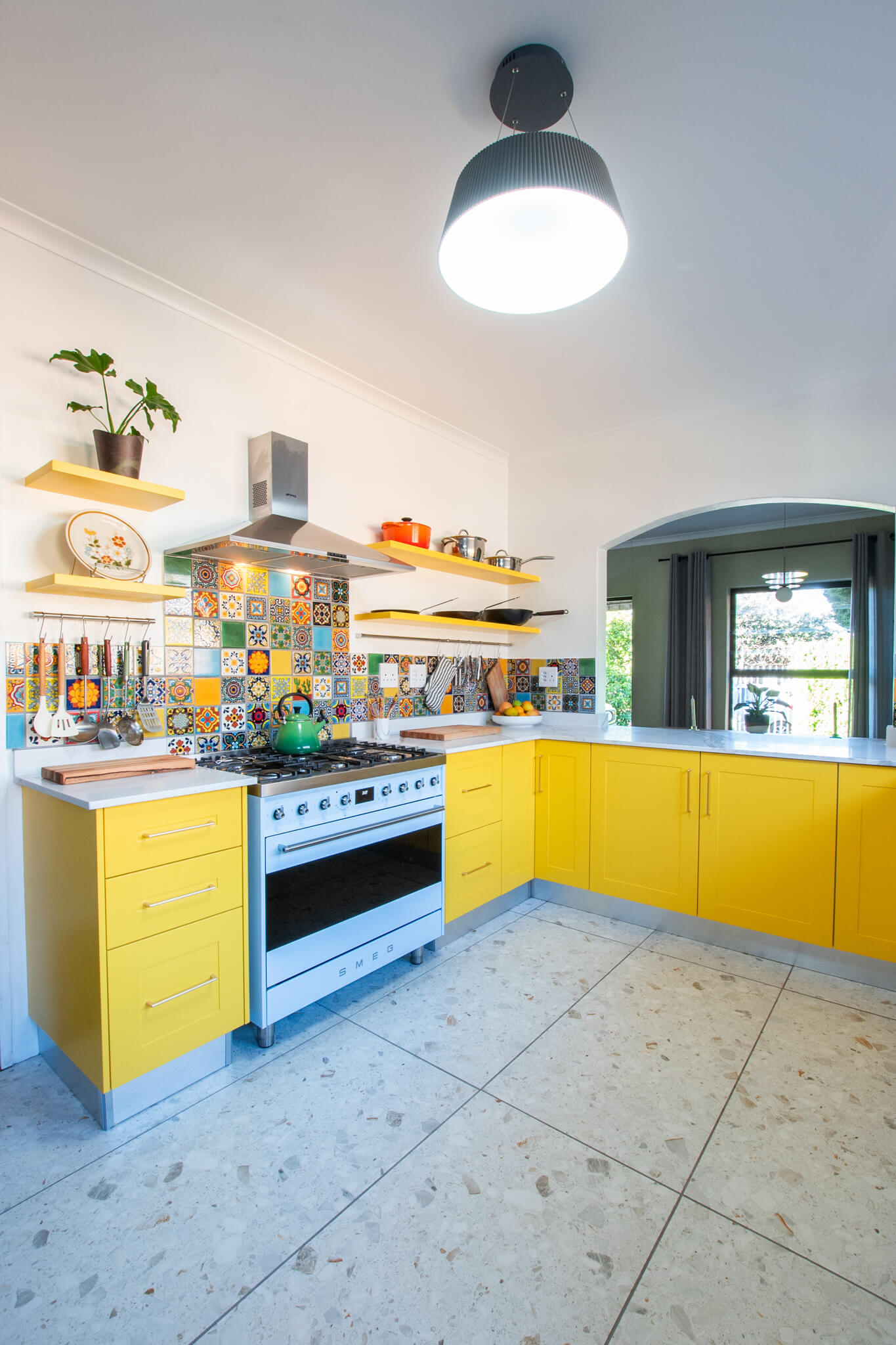
Glass-front cabinets and open shelving can lighten the visual weight of a wall of units, and turn your cupboards into a place to display your favourite glassware, ceramics and cookbooks.
Glass doors come in several looks. Clear glass shows everything inside, while reeded, fluted or frosted glass softens the view and adds texture. Keep in mind that glass doors tend to show fingerprints while open shelves near the hob collect dust and grease quickly, so both need regular cleaning.
Louvred cabinets
Louvred doors are made of angled horizontal slats set within a frame. The repeating lines add rhythm and texture, and the play of light across them gives a relaxed coastal or colonial character. In natural timber they feel warm and organic, while a painted finish in white or soft green creates a breezier, beach-house look.
Louvres are rarely used across a whole kitchen. They’re usually preferred to make a striking accent on an island or a feature cupboard, and they work beautifully in sculleries and laundries where airflow is welcome.
The slats come with trade-offs, though. Each one gathers dust and cooking grease, so louvred doors take longer to clean and their detailed construction also makes them more expensive than plain doors.
Designing kitchen units for different layouts
Your layout influences how easily you’ll be able to work in your kitchen and the mix of cupboards you’ll need.
- Single-wall kitchens: All the units sit on a single run, with tall units adding valuable storage space.
- Galley kitchens: Also known as a walk-through kitchen, cupboards are spread over two parallel runs.
- L-shaped kitchens: Two adjoining runs meet at 90 degrees, creating a corner unit in one section of the kitchen.
- U-shaped kitchens: Three runs meet in two corners to provide a generous amount of cupboard space.
- Kitchens with islands and peninsulas: An island stands freely in the room, while a peninsula extends from an existing run. Both offer cupboard space that’s accessible from either side.
Smart kitchen storage & cupboard organisation
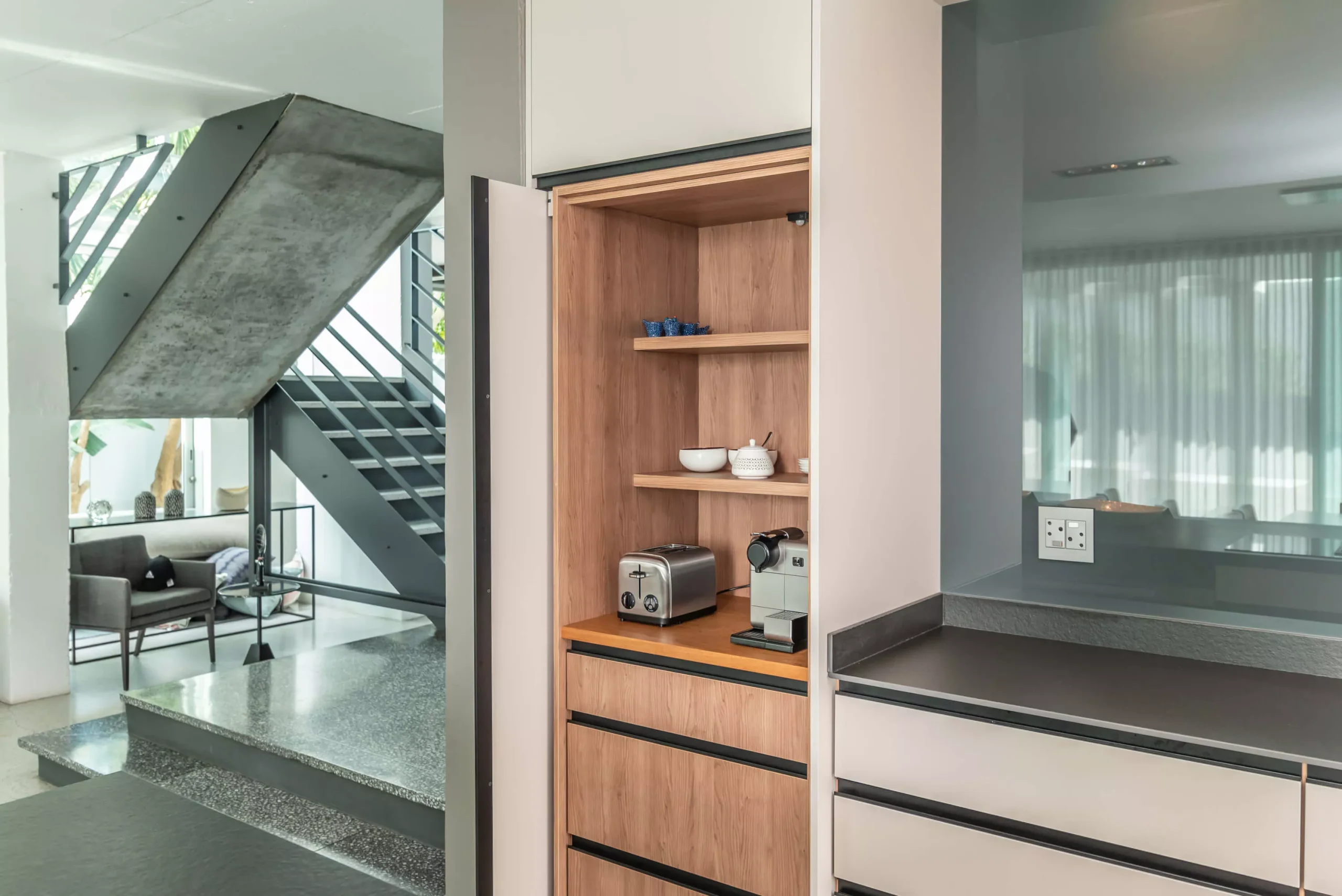
Thoughtful storage starts when you’re designing your kitchen cupboards. Planning internal fittings at the design stage means each unit is built around what it will hold, rather than adapted afterwards.
Pull-out pantries offer a full-height larder that brings every cupboard item within easy reach, while appliance garages keep your kettle, toaster and coffee machine keep gadgets off your counter. In corner units, Lazy Susans and pull-out blind corner organisers bring hard-to-reach items into view.
Installing deep drawers in place of standard base cupboards gives you a full view of what’s stored rather than having to rummage around at the back of dark cabinets. Plus spice pull-outs and drawer dividers give every jar and utensil a place of its own, while an integrated waste bin slides out beneath the sink with space for recycling.
With a little bit of planning at the outset of your kitchen cupboard project, integrating these fittings into your space will help to every cupboard effortlessly ordered in the long run.
Budgeting and installation tips
The cost of your cupboards depends on the size of your kitchen, your door style and finish, your hardware and the internal fittings you choose. While every project is different, there are rough price ranges you can expect your kitchen renovation to fall within:
- Small kitchen (<12sqm): R67,500 to R120,000
- Medium kitchen (12–18sqm): R90,000 to R285,000
- Large kitchen (18sqm+): R140,000 to R405,000+
Estimates cover cabinetry and installation only, and exclude appliances, plumbing, electrical work and tiling. Actual costs will vary with your design and material prices.
DIY installation vs. hiring professional kitchen fitters
Handling your own cupboard installation can be a rewarding project. It gives you full control over the pace of the work and can save you money on labour. With careful measuring, the right tools and plenty of time, it’s entirely possible to DIY your own cupboards.
Keep in mind that this is precise work, though. Small errors tend to compound across a run of units, and a single cupboard that’s slightly out of level can lead to uneven gaps and doors that don’t close properly somewhere else in your space.
Leaving the work to a kitchen specialist brings a few distinct advantages. An experienced designer can advise on the layout and configuration that will make the most of your space, drawing on what they’ve seen work in countless other kitchens.
They’ll also bring a wide range of door, finish and hardware samples to your home, so there’s no need to spend weekends searching for them yourself, and you can see each option in your own light.
Once you’ve made your choices, their team takes care of manufacture and installation, leaving you to enjoy the result without needing to lift a finger.
| Pros | Cons | |
| DIY installation |
|
|
| Professional kitchen fitters |
|
|
Start your kitchen cupboard design makeover today
The best kitchen cupboards don’t just look good, they’re made to last. Whether you’re drawn to the timeless lines of Shaker or the sleek simplicity of slab doors, the right combination of materials and finishes will keep your cupboards looking their best for years to come.
If you’d like expert guidance as you plan, our team would love to help. Book a free in-home consultation through our contact form or call us on 021 554 5290.
![Kitchen designs with prices in South Africa: R75,000 to R1 million [2026 Update]](https://www.select-a-kitchen.co.za/wp-content/uploads/2026/08/luxury-modern-kitchen-design-11-400x250.webp)
![How much does a kitchen renovation cost in South Africa? [Updated 2026]](https://www.select-a-kitchen.co.za/wp-content/uploads/2020/06/Kitchen-cost-blog-400x250.png)